2022 CIVIL SOCIETY ORGANIZATION SUSTAINABILITY INDEX
For Georgia
October 2023
Developed by:
United States Agency for International Development Bureau of Development, Democracy, and Innovation Democracy, Human Rights, and Governance Center
Acknowledgment: This publication was made possible through support provided by the United States Agency for International Development (USAID) under Cooperative Agreement No. AID-OAA-LA-17-00003.
Disclaimer: The opinions expressed herein are those of the panelists and other project researchers and do not necessarily reflect the views of USAID or FHI 360.
ACKNOWLEDGMENTS
A publication of this type would not be possible without the contributions of many individuals and organizations. We are especially grateful to our implementing partners, who played the critical role of facilitating the expert panel meetings and writing the country reports. We would also like to thank the many CSO representatives and experts, USAID partners, and international donors who participated in the expert panels in each country. Their knowledge, perceptions, ideas, observations, and contributions are the foundation upon which this Index is based.
LOCAL PARTNER
UNITED NATIONS ASSOCIATION OF GEORGIA (UNAG)
Otar Kantaria
Nutsa Chinchilakashvili
PROJECT MANAGERS
FHI 360
David Lenett
Alex Nejadian
INTERNATIONAL CENTER FOR NOT-FOR-PROFIT LAW (ICNL)
Jennifer Stuart
EDITORIAL COMMITTEE
Erin McCarthy, Šarūnas Radvilavičius, Jennifer Stuart, Irina LashkhiOVERALL CSO SUSTAINABILITY: 4.0
Russia’s all-out war against Ukraine had a significant impact on Georgia’s domestic and foreign policy in 2022. The Georgian public demonstrated their support for Ukraine, with more than 60,000 people taking to the streets on the day of the invasion. However, the Georgian government’s continued ‘policy of restraint’ towards Russia continued to raise doubts about the country’s alignment with the consolidated stand of the European Union (EU) against Russia’s aggression. In addition, despite popular dismay, the government continued to use hostile language against the Ukrainian leadership for its alleged interference in Georgia’s internal affairs.
Shortly after Russia’s invasion in Ukraine in February, Georgia officially applied for EU membership alongside Ukraine and Moldova. On June 23, 2022, the European Council recognized the “European Perspective for Georgia,” instead of granting it EU membership candidacy as it did for Ukraine and Moldova. In its opinion on Georgia’s application, the European Commission (EC) “recommended Georgia to be granted candidate status, once it has addressed a number of key priorities.” The twelve recommendations proposed by the EC cover a range of issues, ranging from depolarization to ensuring civil society involvement in all decision-making processes at all levels.
According to a report by the United Nations High Commissioner for Refugees (UNHCR), between the Russian invasion of Ukraine in February and November 2022, over 160,000 Ukrainians entered Georgia, which served both as a transit and destination country. As of October 2022, around 25,000 Ukrainians remained in the country. In addition, Georgia experienced a massive influx of Russian citizens escaping increasing repression and possible conscription. According to a study by the Institute for the Development of Freedom of Information (IDFI), between March and June 2022, 277,698 Russian citizens entered Georgia through all border checkpoints. While the overall number of entries is on par with the pre-COVID annual averages for Russia, statistics indicate that a large portion of Russians coming to Georgia intend to settle for long periods. The intense presence of Russian nationals, especially amid the war in Ukraine, fueled an increase in political polarization about Georgia's political trajectory and Western integration.
The Russian influx also helped fuel rapid economic activity, while also raising concerns about the country’s level of dependence on Russia. The National Statistical Service of Georgia estimates that the country’s gross domestic product (GDP) grew by 10.1 percent in 2022. According to Transparency International Georgia, in 2022, the country’s income from Russia through remittances, tourism, and the export of goods amounted to USD 3.6 billion, three times that in 2021. An estimated 15,000 Russian companies were registered in Georgia in 2022, sixteen times more compared to 2021.
Despite the drive to enter the EU, the state of democracy and civic space in Georgia continued to deteriorate in 2022, reaching a low point in early 2023 when the ruling party introduced the “foreign agent” law—a copy of a repressive Russian law and the most overt attack on civil society and freedom of expression in Georgia to date.
The law was first introduced as an initiative by the People’s Power, created by a group of ruling party members who never actually left the ruling party ranks, in December 2022 and was officially introduced in parliament in February 2023. The law would require entities that receive 20 percent of their annual revenue from “foreign powers” to register themselves as “agents of foreign influence.” The introduction of the so-called Russian law triggered a major domestic political crisis, with tens of thousands of people taking to the streets in the capital, Tbilisi, to protest the initiative, fearing the country’s slide to autocracy. International partners such as the US Ambassador and EU member states warned that the law could pose a threat to Georgia’s Western integration. The President of Georgia also refused to support the initiative. The ruling party was ultimately forced to withdraw the bill in March 2023.
In January 2022, in another indication of the country’s democratic erosion, the State Inspectorate, an independent state body charged with monitoring personal data protection and probing abuse of power, was abolished after the agency found the Justice Ministry and its Penitentiary Service to have violated the personal data protection law. Despite the backlash on both international and domestic levels, state officials moved forward with the process, fast-tracking a new legislative initiative to create two new agencies, the Special Investigation Service and Personal Data Protection Service.
The onset of the war in Ukraine spurred new waves of anti-Western disinformation in Georgia. The anti-western narratives emphasized two alleged threats: a supposed Western conspiracy to push for a “second front” in Georgia to weaken Russia’s focus in Ukraine and Russia’s potential military retaliation should Georgia fully join the West in its support of Ukraine. Far-right political groups and media outfits, as well as ruling party leaders and their associated media, actively circulated these narratives, which portrayed CSOs as agents of the “global war party” that intended to “drag Georgia into war” with Russia.
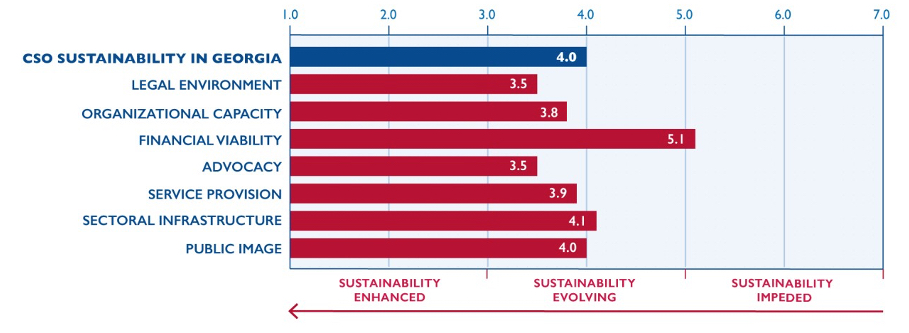
In spite of the challenging context, overall CSO sustainability remained unchanged in 2022. The legal environment and financial viability both deteriorated slightly during the year, while service provision improved slightly. All other dimensions remained unchanged. Local CSOs remained at the forefront of all major social, political, and economic developments in the country, providing assessments, opinions, services, and solutions to a wide range of clients, and the sector continued to actively advocate for reforms and improvements in human rights, accountable governance, and other key policy areas.
Legally, CSOs operate as non-entrepreneurial (non-commercial) legal entities (NNLE). According to the National Agency of Public Registry (NAPR), there are 31,339 registered NNLEs in the country, but only 4,051 are recognized as “active” by the National Statistical Office of Georgia. The large discrepancy between the number of active and registered entities is due to the cumbersome liquidation procedure, which most CSOs tend to avoid. The total number of registered NNLEs is also misleading as, in addition to CSOs, NNLE status is held by a range of public institutions that are owned and operated by municipal or central governments. The new Law on Entrepreneurship is expected to resolve this issue, as all legal entities are required to re-register.
The situation in the occupied regions of Georgia—Abkhazia and South Ossetia—remained tense in 2022. In the aftermath of Russia’s invasion of Ukraine, Russian disinformation capitalized on the false premise of a ‘second front’ in the occupied regions of Georgia, cultivating public fears of a possible Georgian incursion. The EC’s August 2022 Association Implementation Report on Georgia states that “The environment for engagement in Abkhazia and for local civil society to operate continues to deteriorate, partly due to increased pressure from Russia.” In mid-2022, the de facto foreign ministry barred global humanitarian organization Action Against Hunger from carrying out a project that it claimed would promote “the goals and objectives of Tbilisi by organizing Georgian-Abkhaz meetings of a political nature.”
LEGAL ENVIRONMENT: 3.5
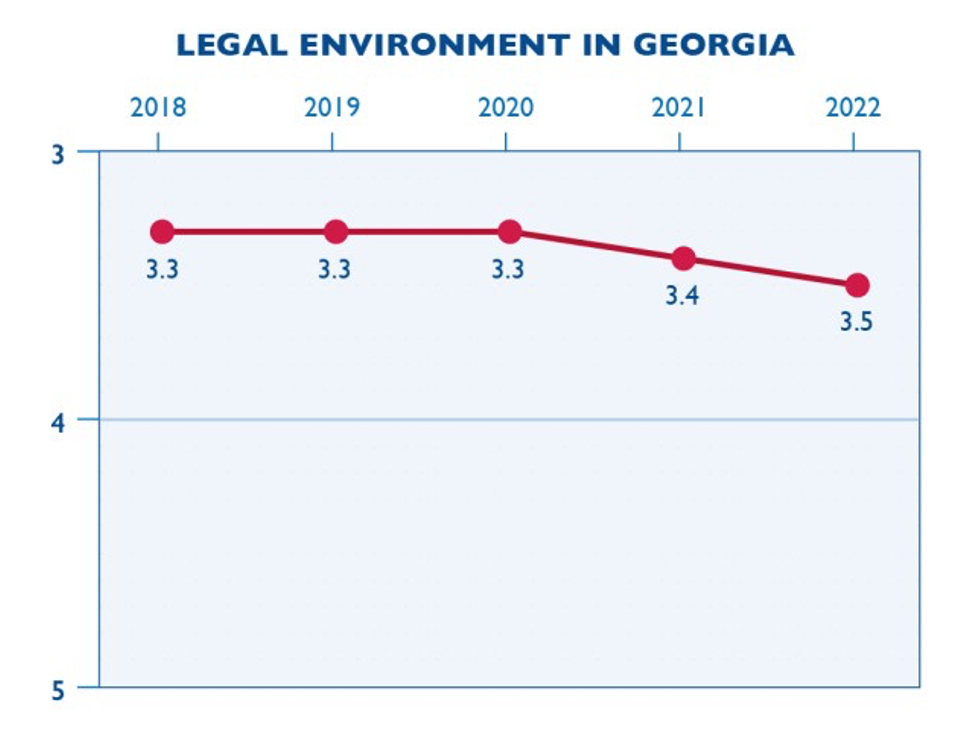
The legal environment governing the work of CSOs deteriorated in 2022, setting the stage for even bigger declines in 2023. Recent changes to the Law on Entrepreneurship require organizations with NNLE status to update their information and, in most cases, to re-register, while the draft law on “agents of foreign influence” threatened to undermine the independent operation and viability of the civil society sector at large.
The new Law on Entrepreneurship, adopted in 2021, requires all legal entities registered before January 1, 2022, to re-register by January 1, 2024, when the law comes into force, with an additional three-month term after the deadline expires. Re-registering under the new law will impose additional financial and administrative burdens on CSOs, and failure to meet the new requirements within the prescribed period will result in the annulment of registration status. The law also introduces new requirements, including three-year terms for directors, and changes the rules for choosing the name of a legal entity. Names that incite resentment on any discriminatory grounds, are contrary to public order and generally accepted moral standards, or use words that indicate approval and/or propagation of violence and/or violations of Georgian law are now forbidden. In addition, the new law prohibits advocating the violation of the country’s independence or territorial integrity, or inciting national, sectarian, religious or social strife, war, or terrorism.
While CSOs generally find the spirit of the new regulations acceptable, they criticize the government for its complete disregard of public consultations in the process of drafting the law. Given the government’s escalating hostility towards CSOs, some experts also fear that the government may misuse the new regulations to selectively deny registration or re-registration.
CSOs are able to register freely. Registration templates for organizational statutes are publicly available on government websites and at Public Service Halls operated by the Ministry of Justice. The registration process can be completed within one working day or on the day of registration for double the fee. In 2022, standard registration fees increased from GEL 200 (approximately USD 77) to GEL 400 (approximately USD 153); same-day registration still entails double the fee. Re-registration is subject to these same increased fees. The only restrictions on who can register or become a member of a CSO are on civil servants and persons under the legal age.
Although CSOs generally operate free from government interference, certain laws and practices create barriers to CSO activism, operations, and services. The Law on Assemblies and Demonstrations, for example, is often criticized for being vague and subject to interpretation. According to the law, ongoing assemblies can “be terminated immediately upon the request of an authorized representative” if the articles of the law are “massively violated,” without specifying what exactly is considered to be a massive violation.
The unclear nature of the legislation allows for the possibility of arbitrary detention and the use of force against protesters. In March 2022, at least twelve people were detained by the police following pro-European rallies organized to criticize the Georgian government’s decision to refrain from imposing sanctions against Russia. One of the arrested activists, who reportedly threw eggs at the Georgian Government Chancellery, was sentenced to four days in prison. The court’s ruling was deemed as “selective, disproportionate and unsubstantiated” by representative of the Georgian Young Lawyers’ Association (GYLA) and Transparency International Georgia, among others.
In late 2022, ruling party members announced they were working on two draft laws to regulate the transparency of CSOs by mandating a registry of “agents of foreign influence” and “regulating the dissemination of fake news by the media.” The draft laws, initiated by the People’s Power—a newly launched faction within the ruling party— received the full support of the ruling party. The draft laws were eventually withdrawn in March 2023 amid massive public protests and international pressure.
Georgian law allows CSOs to mobilize financial resources through fundraising. CSOs may also conduct economic activities, such as selling goods and services, and access various government grants. Many CSOs, however, do not pursue government funding due to concerns about the politicization of grantmaking mechanisms.
CSOs are generally taxed the same as businesses, although tax legislation allows CSOs to request refunds on value-added tax (VAT) on their grant expenditures. Most donors allow CSOs to retain the recovered funds. Additionally, agreements between Georgia and several foreign governments, such as the US and EU, waive VAT payments altogether. CSOs are only required to pay property tax in proportion to their non-grant income that is classified as commercial/economic activity. As reported in the study Assessment of the Legal Environment for CSO Financial Sustainability and Corporate and Individual Philanthropy (2022), prepared by the International Center for Notfor-Profit Law (ICNL) and the European Center for Not-for-Profit Law (ECNL) based on statistics from the State Revenue Service (SRS), only 736 CSOs paid property tax in the first eight months of 2022. Corporate donors are technically eligible for deductions on a minor portion of their gross income.
Both the government and CSOs provide free legal services in Tbilisi and the regions, via email and hotlines. CSOs are also likely to need the help of lawyers to re-register under the new Law on Entrepreneurship, which is expected to strain local legal capacity as the deadline nears.
ORGANIZATIONAL CAPACITY: 3.8
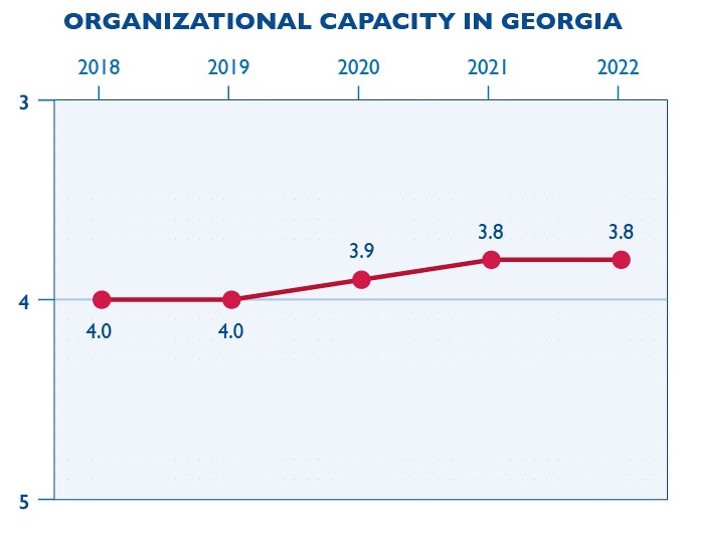
The organizational capacity of CSOs remained unchanged in 2022. Tbilisi-based organizations continue to lead the pack in terms of organizational capacity, with greater access to donors, networks, and other resources.
Local CSOs are mostly value-driven and strongly dedicated to serving their target communities. However, donor dependency and project-focused funding makes it difficult for many, especially those that operate outside the capital, to strategize and plan long-term. CSOs increasingly use social media platforms to build relationships with constituencies but lack sufficient skills and resources to communicate effectively. Many industry and professional associations representing large groups of professional constituencies exist, but few have developed sound institutional structures.
While most CSOs have boards of directors, they generally only exist on paper. The recent changes to the Law on Entrepreneurship may have a positive influence on the composition of CSOs’ governing structures. Local CSOs’ management structures have improved significantly over the past decade, but it is difficult to see change from year to year. Donors typically require adequate compliance systems to be in place, which are usually verified through pre-award assessments and closeout audits. However, funding gaps, uncompetitive salaries, and high staff turnover make it difficult for many CSOs to apply these systems fully and consistently in practice. Local CSOs struggle to offer competitive pay. Staffing challenges also often limit local CSOs’ ability to meet donor reporting requirements.
Volunteering expanded rapidly in response to the COVID-19 pandemic and the war in Ukraine, but remains underdeveloped. According to the 2022 World Giving Index produced by Charities Aid Foundation, 22 percent of respondents in Georgia reported volunteering in 2021. The recent Study of Philanthropy and Volunteering Activities: International Practice and Georgia (2022), produced under the Civil Society STAR Initiative, outlines the lack of financial and legal incentives to promote “a culture of philanthropy and volunteering and the establishment of an appropriate ecosystem in the country.” The study highlights the need to refine the Law on Volunteering to create a more unified regulation of taxation, grants and public procurement, and related areas. It also proposes the creation of incentives for volunteering, including insurance packages for volunteers and giving educational institutions the right to grant training credits for volunteer work.
Technical advancement continues to be a challenge for CSOs, especially those operating in the regions. Due to the lack of diversified funding opportunities, a very limited number of organizations are able to purchase new equipment on a regular basis. Some organizations struggle to retain office spaces. Local CSOs find it difficult to create and maintain well-established organizational websites. Moreover, increased internet-based attacks and disinformation strategies have made cybersecurity a bigger concern for CSOs. However, only a few wellestablished organizations can afford advanced VPN systems and private institutional domains to respond to these new threats.
FINANCIAL VIABILITY: 5.1
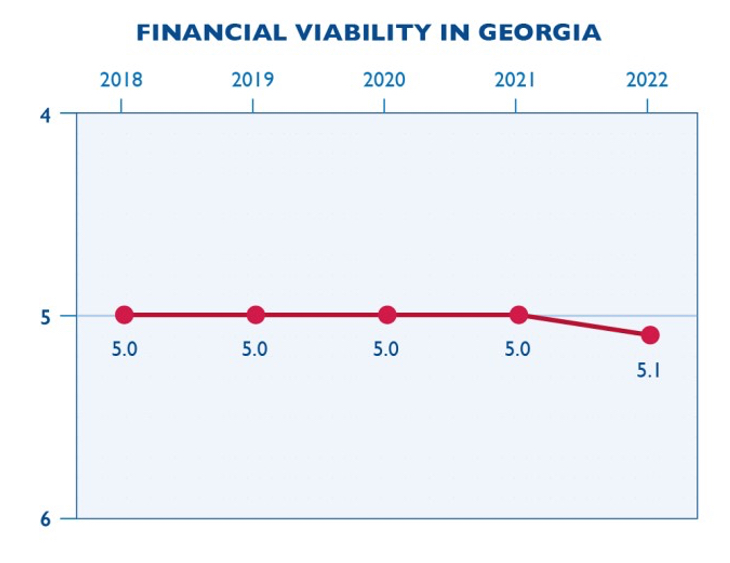
Financial viability deteriorated slightly in 2022, driven by the declining availability of funding for local CSOs and crippling inflation. In addition, the introduction of the draft “foreign agent” law deepened the distrust between CSOs and the state, making it less likely that CSOs will apply for government funding in the future.
CSOs can receive financial support from both local and international donors. However, financial viability remains a core challenge for Georgian CSOs, regardless of their location or size. Most CSOs struggle to diversify their sources of income, and many depend on a single donor, which undermines their long-term sustainability.
According to the annual CSO Meter study, conducted by ECNL, international donors remain the main source of income for CSOs. Development assistance funding for Georgia peaked in 2020 amid the COVID-19 crisis, doubling from USD 540 million in 2019 to USD 1.1 billion in 2020, according to data from the Organization for Economic Cooperation and Development (OECD). Although data is not yet available for 2022, funding levels have substantially declined since 2020, as COVID-19 recovery funds have expired and many donors started shifting funding towards Ukraine.
Most international funding continues to go directly to international organizations, including United Nations (UN) agencies, such as the UN Development Programme (UNDP) and UN Children’s Fund (UNICEF). Local CSOs are still unable to compete directly for most of the available EU and USAID funding as they lack adequate knowledge, human resources, and compliance systems. Although local CSOs are rarely able to serve as the prime recipients for larger funding opportunities, they receive some of this funding through smaller subgrants that are passed down under the prime awards. While an important source of funding, subgrants provide limited opportunity for the longterm organizational development of the recipients. There are some positive developments in this regard, however. In 2022, for example, USAID/Georgia awarded the $20 million Unity through Diversity program to the United Nations Association of Georgia (UNA Georgia), a local CSO, thereby setting an important precedent for future programming strategies.
In the face of the global reform processes being undertaken by the Open Society Foundations (OSF), the Open Society Georgia Foundation (OSGF) is set to localize in the coming years without continued financial backing from OSF. OSGF’s expected exit as the key grantmaker for local activist groups, informal movements, media, human rights defenders, and smaller CSOs, especially those in the regions, will further deteriorate the already difficult financial position of the sector.
CSOs have access to state funding mechanisms, including grants, public procurement, and program funding from local governments. However, CSOs rarely compete for government funding and procurements due to a lack of transparency in selection and award procedures, as well as the administrative harassment and reputational risk that state funding may entail. Growing distrust between the two sectors has further decreased the likelihood of Georgian CSOs applying for government-offered funding opportunities.
Domestic philanthropy—from both individuals and corporations—is still a relatively insignificant source of funding for the sector. This is partly due to the lack of legislative incentives. Crowdfunding is still nascent but showed promising signs throughout the COVID-19 crisis and the charity drives to support Ukrainian refugees in Georgia. In March 2022, UKRAINA.ge was created to collect donations in support of Ukraine and to connect donors and volunteers with those in need. Within its first year of operation, the site mobilized GEL 1,181,400 (approximately USD 454,000) in the form of monetary and material donations. Corporate philanthropy, while also underdeveloped, also improved significantly during the COVID-19 pandemic, with CSOs, businesses, and government entities taking a joint stand to help those in need.
A few CSOs, such as Partners Georgia (PG) and the Center for Training and Consultancy (CTC), earn income from consulting, training, coaching, and other services that they successfully market to government and business clients. Their revenues started to recover in 2022 after the significant drop during the COVID-19 crisis. However, these organizations still rely on international donor funding to ensure their operational sustainability. There are only a few membership CSOs, but even in these organizations, collected dues are usually insignificant and make minimal contributions to financial viability.
The quality of financial management and compliance systems varies among CSOs. A few larger and more established organizations have sufficient resources to afford advanced financial management systems, as well as experienced and highly qualified staff. Recruitment and retention of experienced financial staff is a challenge, especially for CSOs that operate outside of the capital city. CSOs generally disclose information about their donors, as well as the amounts received and priorities of the projects they implement, but few conduct annual audits and only a handful make their audit reports or more detailed financial information public.
ADVOCACY: 3.5
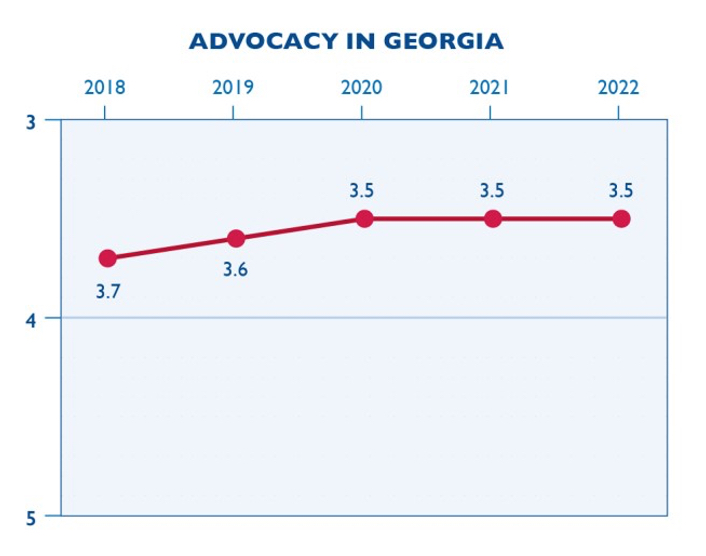
CSO advocacy remained unchanged in 2022. CSOs’ participation in decision-making processes both at the central and local government levels is ensured by law. The right to participate includes the ability to lobby, petition, initiate laws, attend parliamentary sessions, and participate in working groups and meetings, among other actions. However, CSOs continued to face challenges in exercising these rights during the year, including the continuing disinformation and hate campaign against them and the decline in cooperation with the national government.
Despite government-imposed barriers to the substantial involvement of civil society in policy making, CSOs continued to influence national discussions and political agendas both locally and nationally. The EC’s Association Implementation Report on Georgia, published in August 2022, notes that “civil society organizations remained very active and involved in monitoring the implementation of the AA [Association Agreement], including the DCFTA [Deep and Comprehensive Free Trade Areas], in policy formulation, and in holding the government accountable, including to some extent at the local level.”
Georgia’s EU aspirations were the overarching focus of CSO advocacy in 2022, with many Georgian CSOs quickly mobilizing to advocate for progress on the twelve recommendations put forward by the EC to grant Georgia EU candidacy. Twenty-three local and international organizations developed a plan outlining a unified vision of the steps to take to meet the twelve conditions. The proposal included substantial strategies focused on strengthening cooperation among the parties by establishing multi-party committees and adopting impartial selection procedures, amongst many others, claiming that the reforms “can be implemented by the end of 2022 if there will be the political will to do so.”
The government ignored this plan and continued to limit CSO participation in decision making, including within the parliamentary working groups that the ruling party launched to implement the EC’s recommendations. For example, the International Society for Fair Elections and Democracy (ISFED)—Georgia’s leading elections watchdog—was rejected from participating in the parliamentary working group on electoral issues. In protest, GYLA—a leading human rights and legal aid champion—also refused to participate in the working group, while many leading CSOs issued individual and joint statements calling on the ruling party to change its decision.
Another incident showing the ruling party’s inconsistency in addressing the EC’s recommendations involved the selection of the Public Defender. Soon after the EC’s conditional recommendations were made public, the ruling party proposed a new, more inclusive rule for the selection of the Public Defender. The parliamentary minority was granted the lead on selecting a candidate, which they did with the full involvement of CSOs. After a lengthy selection process, including discussions and televised interviews, however, the ruling party refused to vote for the CSO-backed candidate and scrapped the entire process.
Similarly, even though one of the EC’s recommendations focused on increasing civil society involvement in decision making, People’s Power spearheaded the failed “foreign agent” legislation at the end of 2022 and early 2023. CSOs actively pointed out the proposal’s inconsistency with EU requirements and democratic principles and raised awareness about its shortcomings and controversial nature among the wider public. In addition to issuing individual and joint statements, CSOs helped organize large-scale rallies against the controversial bill in March 2023. After the law was withdrawn, CSOs lobbied in support of the rights of citizens who were forcibly detained by the police during the protests and called on the Special Investigation Service to examine the use of disproportionate force by law enforcement officers during the rallies, leading to the launch of an investigation into the alleged instances of abuse of power.
Public institutions responded less frequently to freedom of information (FOI) requests in 2022. According to IDFI, the rate of complete responses to FOI requests in 2022 was just 33 percent, the lowest rate since 2010. State LLCs and NNLEs rejected or left unanswered the largest number of requests, with state-owned entities rejecting or not responding to 90 percent of requests.
Local CSOs have an extensive history of cooperation with international partners and both public and private sector actors. Each September since 2015, for example, the Economic Policy Research Center (EPRC), in partnership with the McCain Institute at Arizona State University, has organized the Tbilisi International Conference, a large-scale event that brings together regional experts on foreign policy, security, and democracy issues to discuss Georgia’s democratic progress and transatlantic aspirations. The 2022 conference focused on the challenges posed by the invasion of Ukraine and its implications for the region and beyond.
In contrast to their exclusion of civil society in decision making on political issues, both the ruling party and the executive branch remained mostly open to productive collaboration with CSOs in non-political areas, such as infrastructure, environment, education, health care, and animal rights. Partnerships with local governments are also generally productive only in non-political areas, as the local authorities remain heavily dependent on Tbilisi in their decision making. Decentralization has been on Georgia’s political agenda for two decades, but without any meaningful success yet.
SERVICE PROVISION: 3.9
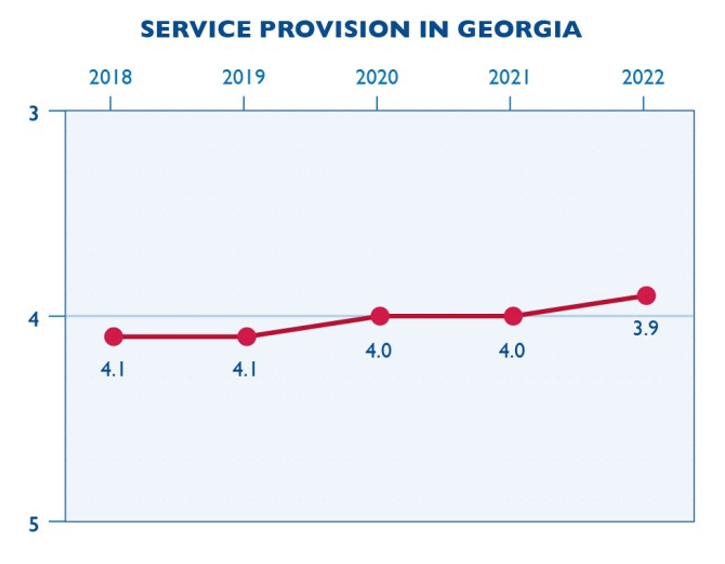
CSO service provision improved slightly in 2022 as CSOs demonstrated their capacity to respond to the constantly changing needs of diverse groups of constituents and develop effective crisis response mechanisms.
CSOs provide a wide range of health, education, relief, employment, environment, governance, and other services to communities, government, and businesses. According to the EC’s Association Implementation Report on Georgia, “During the COVID-19 crisis, civil society played an important role in supporting those in need and complementing state assistance.”
In 2022, CSOs actively responded to the needs of the refugees that came to the country after the Russian invasion of Ukraine. Services provided included psychosocial assistance, cash assistance, humanitarian aid, health-care services, and access to education. For example, a group of volunteers launched Dopomoga Ukraine, which provides refugees with updated information on public services, accommodation, legal issues, support services, and charities. Many leading international organizations operating in Georgia, including UNHCR and UNICEF, also launched new projects and initiatives to support Ukrainian refugees, providing funding to local organizations to implement the projects.
Since the start of the war, both Georgian and Ukrainian nationals have formed a number of new CSOs to support Ukrainian refugees arriving in Georgia. For example, a local Georgian resident and a refugee from Ukraine founded NGO Sauk-2022, which operates in Gori in the Shida Kartli region, to assist newcomers in various ways, including with language barriers.
Economic development is another growing area of CSO services. A 2021 study by the Georgian Institute of Politics identified at least thirty-one Georgian CSOs that are actively working with small and medium enterprises to strengthen value chains, increase sales, or explore exports through various EU and USAID projects. There has also been a steady increase in the number of industry and membership associations that provide a variety of services to their members. The Small and Medium Enterprise Development Association (SMEDA), for example, was established in 2021 and has grown rapidly in terms of membership and services. SMEDA provides tax, audit, training, legal, and other services to its members, while also offering a range of educational programs and opportunities to the public.
CSO services usually respond to local needs. CSOs actively interact with their constituencies and use various feedback and data collection tools including surveys, focus group discussions, and key informant interviews to continuously identify constituents’ needs and interests.
CSOs and the government are the primary clients for most CSO services. Businesses are also important clients for the few well-established training and consulting organizations, such as PG and CTC. Georgian CSOs tend to be value-driven organizations, generally maintaining high standards of integrity in partnerships, as well as equality in the production, marketing, and delivery of their projects and services.
While many CSOs generate some income from services, this income generally is not sufficient to sustain them. Limited access to funding and qualified human resources makes it difficult for CSOs to invest meaningfully in diversifying and marketing their product lines.
The government generally recognizes the value of CSOs and the services they provide. The sectors actively cooperate on a variety of non-controversial issues, including the provision of basic social services. Relations have stalled on high-profile issues, however, as the government and the ruling party continue to publicly undermine the credibility of CSOs, their work, and their staff.
SECTORAL INFRASTRUCTURE: 4.1
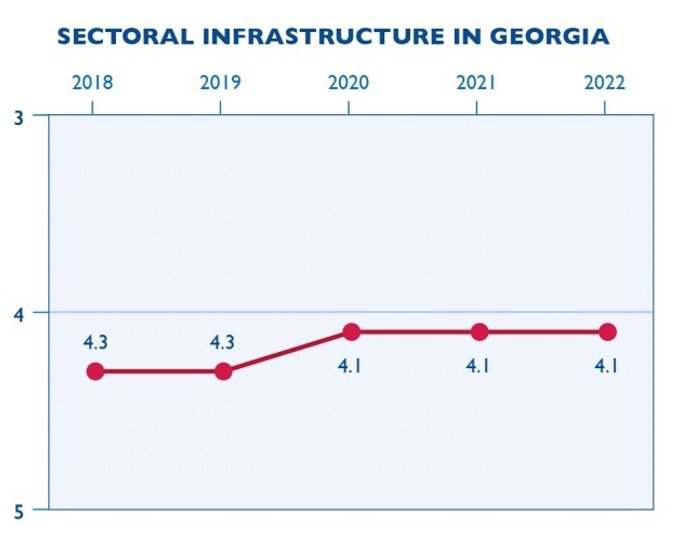
The infrastructure supporting the CSO sector is of a high quality, but its scope and range of services are limited. A few notable examples are the Centers for Civic Engagement (CCE) and the Network of Youth Centers, both funded by USAID, and the EU-funded Regional Coordination Centers (CSO Hubs). The CCEs provide free space and various services to local CSOs, while charging affordable fees to organizations outside the region. CSO Hubs provide a wide range of services such as capacity building, information support, and other forms of assistance to local civil society groups. The USAID-funded network of Youth Centers, implemented through USAID’s Unity through Diversity initiative, operates in sixteen municipalities across Georgia and serves as a valuable resource for local and national CSOs engaged in youth outreach, awareness, and education activities. The CSO Georgia website, created by the Civil Society Institute (CSI) with financial support from OSGF, Bread for the World, and the EU, remains the largest CSO-focused information resource.
Local grantmaking organizations remain few in number. The Europe Foundation and Women’s Fund in Georgia continue to re-grant donor funds to local organizations, but their scopes are limited. The ongoing changes in OSGF’s funding and structure are expected to further limit local grantmaking capacities in the coming years.
Most CSO coalitions are based in Tbilisi. In 2022, CSOs primarily joined forces around the topic of Georgia’s Euro-Atlantic integration. One such initiative formed in 2022 is Take a Step Towards Europe, which unites local civil society leaders, journalists, artists, and public figures. During the launch event in May, participants in the initiative presented a nine-point manifesto outlining Georgia’s future European path. The manifesto highlights the importance of human rights, fair elections, and freedom of speech, among other fundamental rights.
A few coalitions have been active for a long time. For example, the civil society platform No to Phobia! was founded by thirteen CSOs in 2014. Since 2010, the Georgian National Platform of the Eastern Partnership Civil Society Forum has promoted European integration and facilitated reforms and democratic transformations in Georgia. The Coalition for an Independent and Transparent Judiciary, which was founded in April 2011, currently unites forty member nonprofits.
The lifting of pandemic-related restrictions allowed in-person meetings, training events, and conferences to resume at their pre-pandemic pace. Training is mostly offered to CSOs through donor-funded projects, but the range of services is limited to human resource management, strategic planning, fundraising, and other general areas. CSOs have more limited access to quality training opportunities in accounting, financial management, compliance management, reporting, grant writing, and other technical areas. Some CSO support projects create relevant literature, video classes, and other resources on such issues as taxation, proposal writing, grant writing, and related areas. While most of these are publicly available on organizational websites, they rarely reach high target numbers.
Cooperation with the private sector is limited and mostly happens on an ad hoc basis. However, many of the large-scale EU and USAID projects launched within the last two years incorporate cross-sectoral cooperation and private sector engagement as core parts of their agendas. CSOs are working more actively with both small and large businesses as a result, providing capacity building, access to finance, employment, startup incubation, acceleration, export compliance assistance, and other services. In addition, USAID has partnered with larger businesses and employers, such as TBC Bank and Adjara Group. In doing so, it is paving the way for its implementing partners (and their subrecipients) to collaborate with these companies in other areas, including minority inclusion and equality in the workplace. CSOs’ collaboration with the business sector also grew in response to the COVID-19 pandemic and the war in Ukraine. For example, in March 2022, the delivery service Glovo and the Georgia Red Cross launched a joint campaign to collect donations from users of the app to help Ukrainian refugees.
PUBLIC IMAGE: 4.0
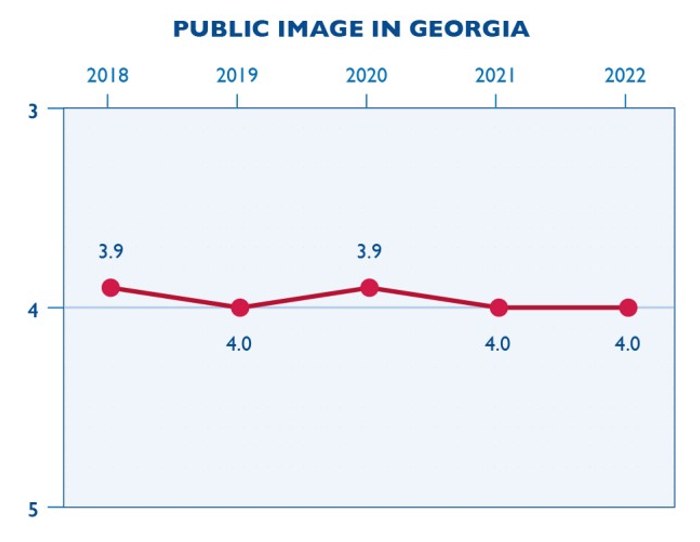
The CSO sector’s public image was affected by both positive and negative developments in 2022, leaving it unchanged overall. CSOs were subject to constant attacks and disinformation that questioned the origins and transparency of their funding, the motives and intentions behind their work, and their alignment with Georgia’s national interests and traditional values. At the same time, however, the massive public opposition to the “foreign agent” law demonstrated the public’s recognition of CSOs’ contributions to Georgia’s civic, political, and economic life. In addition, local CSOs have established a reputation as reliable actors on the international level, which was evident from the backing they received from allies such as the US and EU in the face of domestic attacks during the year.
Most of the media coverage that CSOs receive is focused on ongoing political debates, including EU integration and judicial reform. In 2022, government-critical media tended to solicit CSO commentary on all major political processes, including Georgia’s EU integration prospects, while government-friendly media outlets, which have far greater funding levels and viewership, engaged in continued smear and disinformation campaigns against the leading civil society groups in the country. In September 2022, for example, Imedi TV—Georgia’s largest media group and the de facto communication arm of the ruling party—aired a media report titled “clan of rich NGOs” that cast public doubts on the financial motives behind CSO activism. Imedi TV and the ruling party continued the “rich NGO” rhetoric throughout the year, producing a range of manipulative reports including one that claimed that “rich NGOs are against January 7th / Christmas.”
According to the limited research data that is available from the Caucasus Research Resource Center (CRRC) for 2022 as of the time of this report, only 24 percent of Georgians trust CSOs. However, it is important to note that trust levels in other sectors are also alarmingly low. For example, the same CRRC study indicates that just 23 percent of respondents trust the parliament.
Overall, the public understands the value of CSOs and their contribution to Georgia's Western trajectory. As stated in a September 2022 study carried out by CRRC for National Democratic Institute (NDI), while there is a “ wide public consensus” on the importance of involving CSOs in the process of fulfilling the twelve EC recommendations, only a third believe the government will include CSOs in the process.
There continues to be a perceived “disconnect” between the issues that CSOs address and Georgians’ priorities, largely because local CSOs struggle to communicate about the diversity of services they provide. CSOs actively contribute to many high-priority issues for the Georgian public, including employment, education, health, and other public services. However, only a small portion of this work reaches the media spotlight. Instead, in 2022, most CSO media coverage continued to focus on Georgia’s highly criticized judicial reforms (one of the EC’s conditional recommendations), while only 5 percent of Georgians named the court system as one the three most important national issues in NDI’s December 2022 survey. At the same time, however, public protests against the “foreign agent” law proved there is significant popular support for the work and role of civil society in Georgia.
Both USAID and the EU increasingly support private sector engagement, creating opportunities for local CSOs to do more work in areas that are of high importance and relevance to the public, including employment, economic development, skills training, education, and health care. Increased CSO participation in high-value opportunities such as the start-up economy, value chains, production capacities, exports, and vocational education is helping to boost the image of CSOs among the private sector and the public. Georgian media increasingly covers such stories as well, allowing CSOs to better promote the services and opportunities that they create through donor-funded programs.
The government continued to attack CSOs both directly and indirectly through government-controlled media and other channels. The negative rhetoric from members of the ruling party towards civil society reached a tense point in September 2022, when the party chair and other members of parliament openly questioned the income and financial transparency of several organizations.
CSOs increasingly use social media platforms to communicate and increase their visibility. They lack human and financial resources, however, to effectively translate their work into media and social media products, limiting the reach of the highly important and relevant knowledge products, services, and processes that they create.
The ruling party's narratives in 2022 focused on the lack of transparency in CSOs’ funding, implying malign influence operations by the US and the EU. In reality, however, local CSOs generally demonstrate a high degree of transparency in their operations, with the majority providing comprehensive information about the projects they undertake and the sources of their funding. While there is a code of ethics for CSOs spearheaded by CSI, a local legal advocacy group, the sector’s accountability, ethics, and operational integrity are also effectively regulated by donor guidelines.